
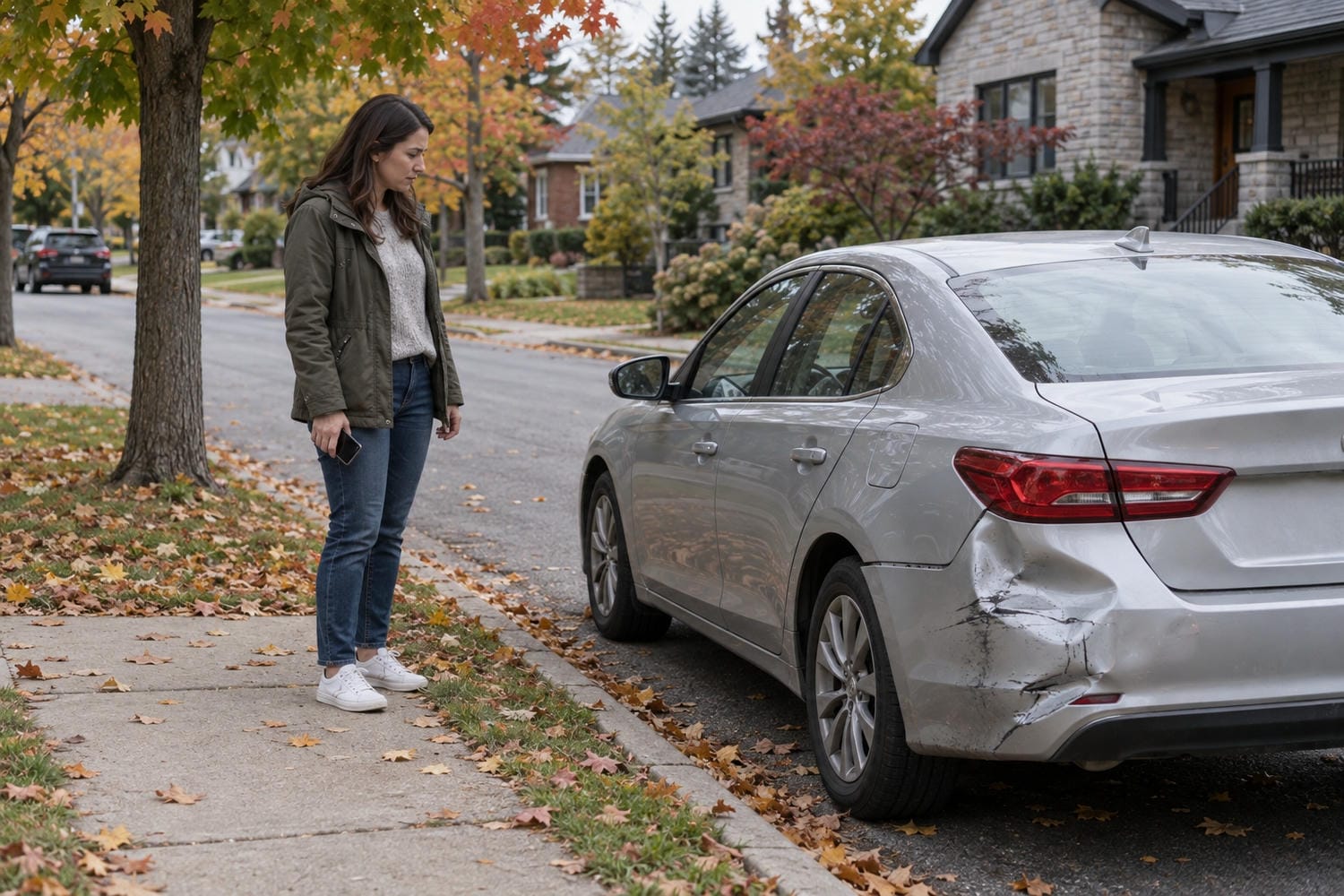
A car accident settlement in Ontario is the money paid to close an injury claim, and the honest answer to what one is worth starts with a range rather than a number. Settlements in Ontario car accident claims run from a few thousand dollars where the injuries resolve, up to several million where someone is catastrophically injured and will need care for life. Where a particular claim sits inside that range depends on how permanent the injury is, what it costs to live with, and what the person can still earn. Most people picture one cheque from one insurer, and that is the largest misunderstanding about what a car accident claim involves: there are two claims, they settle separately, and almost everything that frustrates people later follows from that. The rest of this page covers what sets the value, what comes off the top, how long it takes, and what to check before you sign.
Why a Car Accident Settlement in Ontario Is Really Two Settlements
One claim goes to your own auto insurer, which pays for your treatment and recovery regardless of fault. The other claim is a lawsuit against the driver who caused the crash, and it is where pain and suffering, the shortfall in your income, the cost of your future care, and your family’s own claim live. The two settle separately, on different clocks, against different parties. The most severe injuries, the ones the insurance rules call catastrophic, carry much higher benefit limits. The lawsuit is the slower of the two, so people often feel they are being paid nothing while the larger half of their claim is still being built.
| What it covers | Accident benefits claim (your own insurer) | Claim against the at-fault driver |
| Who pays | Your own auto insurer, no matter who caused the crash | The at-fault driver’s insurer, and only if that driver is legally responsible |
| What it pays for | Treatment, rehabilitation and attendant care, plus income replacement where that coverage is in place | Pain and suffering, income loss, future care, housekeeping, out-of-pocket costs, and a claim for close family members |
| Limits on the amount | $3,500 where the injury is treated as a minor one, $65,000 for medical, rehabilitation and attendant care together, or $1,000,000 for a catastrophic injury, unless extra coverage was purchased | No fixed ceiling, but a yearly deductible is struck off the amount for pain and suffering unless the award clears that year’s threshold |
| How long it lasts | Up to 260 weeks, which is 5 years, for most adults, with no time limit if the injury is catastrophic or extra coverage was purchased | Bounded by the 2 year deadline to start the lawsuit, and then by how long the case takes to value and resolve |
| Does fault matter | No | Yes, and the injured person’s own share of responsibility reduces what they recover |
| If it is refused | Apply to the Licence Appeal Tribunal | The dispute is decided in the Superior Court of Justice |
What Decides the Value of an Ontario Car Accident Claim

Five things carry most of the weight, in roughly this order: how permanent the injury is, what you can still earn, what your care will cost, how good the medical record is, and how much of the blame lands on you. It is valued on what the injury does to a life, and then reduced by rules that apply to everyone.
Whether the Injury Clears Ontario’s Threshold for Pain and Suffering
Money for pain and suffering is only available where the injury is permanent and serious. The test has four parts: the impairment has to substantially interfere with your work, your training or your usual daily activities; the function it affects has to matter to those things; it has to have been continuous since the crash and not be expected to improve substantially; and a physician trained in assessing that kind of impairment has to say so, based on medical evidence and accepted standards. Which of the injuries that most often follow a collision you are living with shapes what that evidence looks like and how long it takes to gather. So the size of the crash does not decide this. The medical record does.
The 2026 Deductible That Comes Off Pain and Suffering
In 2026, the court strikes the first $47,913.01 off any award for pain and suffering, and that deduction only disappears once the award is above $159,708.71. The same deductible comes off a modest award and a large one, which is why it hurts smaller claims most, and why a claim that sounds like it is worth something can be worth very little once it applies. The deduction applies to the award for pain and suffering only. It does not touch income loss, care costs or the out-of-pocket parts of the claim. These amounts reset every January, so the figure that applies to your claim is the one in force for that year, published by Ontario’s insurance regulator.
Income Already Lost and Income Still to Come
Two calculations sit behind the income part of a claim, and most people assume both are simply their lost wages. Income you lost between the crash and the trial is recoverable at 70% of your gross earnings for that period, not at 100%, and that is a different rule from the benefit your own insurer pays. Income loss going forward is worked out differently again: after income tax, Canada Pension Plan contributions and employment insurance premiums come off, which is why the income figure in a settlement is smaller than the salary on a pay stub. People who can still work but are worth less in the job market than they were have a separate part of the claim for loss of competitive advantage.
What the Care Will Cost, and Why It Lands in the Lawsuit
For most adults with a non-catastrophic injury, the benefits side stops after 5 years, and the combined medical, rehabilitation and attendant care benefits stop at $65,000, unless extra coverage was purchased. Someone who will need treatment, equipment, help at home or a modified house for decades is therefore facing a cost the benefits track was never built to carry. That cost has to be proved with evidence and recovered from the at-fault driver, which is also why serious claims are expensive to build and slow to value. Two smaller parts of the claim get missed: the housekeeping and home maintenance you can no longer do, and the out-of-pocket costs you have been covering since the crash.
What Close Family Members Can Claim
Close family members of someone injured or killed by another driver’s fault have a claim of their own. It covers the expenses they paid on the injured person’s behalf, the value of the nursing, housekeeping and other care they provided themselves, and an amount for the loss of the injured person’s guidance, care and companionship. A deduction is attached to that last part: in 2026, $23,956.52 comes off a family member’s claim for loss of guidance, care and companionship, and it disappears only once that claim is above $79,853.70.
Your Own Share of the Blame
A share of responsibility reduces what you can recover from the other driver in proportion to that share, so a finding that you were half responsible cuts the recovery in half. In car cases the argument is usually about the same handful of things: whether a seatbelt was worn, speed, distraction, and whether you could be seen in time. It is also the one factor on this list that is argued rather than measured. Your own accident benefits are not decided by fault at all, so treatment funding does not wait on that argument.
What Gets Deducted Before the Money Reaches You

There is a gap between the number people hear and the number that arrives, and three things sit in it: benefits and other payments you have already received, the deductible on the pain and suffering part, and legal fees and disbursements. The first two are set by rules that apply to every claim, not by negotiation.
Benefits You Have Already Received Come Off the Matching Part of the Claim
Accident benefits already paid are not pooled and taken off the total. They come off the matching part of the award: income benefits reduce the income loss part, treatment and care benefits reduce the treatment and care part, and other payments reduce the matching other part. The Court of Appeal for Ontario has explained the reason in plain terms: people should be fairly compensated for a loss, and not compensated twice for the same one. The principle follows the claim past the settlement as well, so benefits paid afterwards for a loss that has already been compensated are held for the insurer rather than kept.
Sick Pay, Disability Benefits and Other Income During the Recovery
The deductions run wider than accident benefits. Damages for income loss are also reduced by payments you received or had available before trial under an income continuation plan, and by employer sick pay. The repayment question comes up constantly, and the general shape is this: in a car accident claim, benefits you have already received are normally handled by subtracting them from the matching part of your claim rather than by paying anyone back out of your settlement. How your own disability plan treats a settlement is set by that plan, so have its terms reviewed before you sign anything.
Legal Fees and Disbursements
This is the part people phrase as how much do lawyers take. A contingency fee agreement has to be in writing, and it has to be on the standard form every Ontario firm is required to use, so you can compare one firm’s agreement with another’s. The fee cannot be more than what you recover, leaving aside disbursements and taxes. Disbursements are the money a firm pays out while the case runs, for medical records, expert reports and court filings, and they come back out of the recovery. Our fee is a percentage of what we recover for you, it is set out in that standard agreement, and you will see the number before you sign anything. We work on a No Win, No Fee basis.
What the July 2026 Coverage Changes Can Mean for What Gets Subtracted
The coverage changes that took effect on July 1, 2026 reach the deduction side of a settlement in a way that is easy to miss. An income replacement benefit that would once have been subtracted from the income loss award may simply not exist on a newer policy, so for some claimants there is less to deduct. That is not the same as being better off. When less of the loss arrives as a benefit, more of it has to be proved with medical and expert evidence inside the lawsuit, which raises what it costs to build the file and makes the threshold test decisive for more people. If your policy was entered into or renewed before July 1, 2026, the older coverage still applies to it until it renews.
How Long a Car Accident Settlement Takes in Ontario, and What Sets the Pace
A claim can only be valued once your medical condition has settled into a pattern a doctor can speak to, so the honest timeline is driven by your recovery rather than by the court schedule. The negotiation still has to happen inside fixed deadlines. In Ontario a lawsuit over a car accident generally has to be started within 2 years, and there are separate, much shorter deadlines on the benefits side, which is why the deadlines that apply to an Ontario car accident claim are worth mapping out early rather than discovering one at a time.
Why the Medical Picture Sets the Pace
The test that decides whether pain and suffering is recoverable at all asks whether the impairment has been continuous since the crash and is expected not to improve substantially, proved by a physician trained in assessing it. That question cannot be answered while you are still in active treatment and still changing month to month. An offer made at that stage is priced on an uncertain picture, and uncertainty is priced in the insurer’s favour. So settling early does not buy a faster version of the same number. It buys a different one, and usually a smaller one.
The Stages a Claim Moves Through
A lawsuit moves through the same stages in the same order: a written claim and a written defence, an exchange of documents, questioning under oath, a medical appointment arranged by the other side, a mediation, and a pretrial in front of a judge, with a trial date that is assigned rather than chosen. Where the mandatory mediation program applies, which is Toronto, Ottawa and Windsor, the mediation has to happen within 180 days after the first defence is filed, unless the court orders otherwise or the parties agree. These stages run on the court’s calendar rather than on either party’s, which is why the file has to keep moving forward even while settlement talks are live.
What Has to Be Handed Over in the First Few Months
Before a car accident lawsuit can move, your lawyer has to give the other driver’s lawyer a set of specific things: the name of your own insurer, proof of your income for the 52 weeks before the crash where income loss is claimed, and copies of your accident benefits application, any applications for other benefits, and the medical reports and clinical notes. Each of those carries its own short deadline. The reason it matters to you is simple: a settlement discussion cannot start until the other side can see the same file you are looking at, so gaps in records are the most common reason an early claim stalls.
Before You Sign Anything

The most consequential moments in a claim are the ones where paper gets signed, and they tend to arrive when you are least ready for them: money is short, treatment is ongoing, and an offer lands with a deadline attached. Two things are worth knowing before that happens.
The 2 Business Day Right to Cancel an Accident Benefits Settlement
When a benefits settlement is put in front of you, your insurer has to give you a signed written disclosure notice explaining it. After that, you have 2 business days to cancel the settlement, counted from the later of the day you sign the disclosure notice and the day you sign the release. If the insurer did not give you a proper notice, the right to cancel lasts longer. A term that tries to stop you from going to the Licence Appeal Tribunal has no effect unless the settlement comes at least 1 year after the accident, or a case conference has already been held. Someone who signed yesterday may still be inside that window.
What a Full and Final Release Actually Closes
A release is not limited to the issue you were arguing about. Signing one normally ends the whole claim it covers, including the parts you have not thought about yet, and including losses that turn out to be worse than they looked at the time. Three assumptions cause most of the damage here: that the release only settles the dispute of the moment, that a later deterioration can be reopened, and that the benefits release and the lawsuit release are the same document. They are not. Those are two separate claims and two separate releases.
How the Money Reaches You
Most settlements are paid as a lump sum. The parties can also agree to pay part of the money as a stream of payments over time, which is called a structured settlement, and it is common where the money has to cover care for decades. Where a court is awarding damages rather than approving a deal, it can order payments over time when two or more of certain circumstances are present, including an award of $100,000 or more and an injured person under 18. The court has that power in those circumstances, and neither side is compelled into a structure.
A settlement for a child, or for an adult who cannot manage their own affairs, is not final until a judge approves it, and their lawyer has to show the court that the deal is reasonable and in that person’s best interests. That money is generally paid into court unless a judge orders otherwise, and for a child it is usually held until they turn 18 and paid out with the interest it earned. The deadline to sue also does not run against a child who has no adult formally appointed to run the claim.
Talk to a Lawyer Before You Agree to a Number
The value of a car accident claim is mostly decided by evidence gathered while the recovery is still happening, and by rules the other side already knows well. That is the argument for getting advice before you respond to a number rather than after. Our team brings more than 30 years of collective personal injury experience, we act on a No Win, No Fee basis, and the first conversation costs nothing. If you want a car accident lawyer to look at where your claim sits, what comes off it, and which deadlines are already running, book a free, no-obligation consultation with HSK Law and bring whatever paperwork you have.
Frequently Asked Questions
Most do resolve before a trial, and many of them resolve at or soon after mediation, once both sides have the same medical picture in front of them. The way that becomes possible is counsel preparing the file as though it will be tried: complete records, properly instructed experts, and a theory of the case that holds up under questioning. A file built that way is also the one that gets taken seriously in negotiation.
The dispute goes to the Licence Appeal Tribunal. The filing fee is $106, and the application has to be made within 2 years of the insurer’s denial notice. The tribunal’s own published pattern gives you a sense of the pace: a first case conference usually 3 to 5 months after the application, a hearing typically 4 to 8 months after that conference, and a written decision usually 60 to 120 days after the hearing. That is the benefits route, and it runs on its own clock.
Yes. They are separate claims against different insurers, and settling one does not end the other. Two cautions go with that. Read which claim the release in front of you actually covers, because a benefits release and a lawsuit release are different documents. And remember that the benefits you have already received will be subtracted from the matching part of the claim against the at-fault driver, so the two numbers are connected even though the claims are separate.
Your own insurer does, regardless of who caused the crash. Medical, rehabilitation and attendant care benefits remain part of every auto policy in Ontario. Where the injury is treated as a minor one, treatment funding stops at $3,500, which is the point at which many people discover how much of their claim lives on the other track. If you disagree with that classification, it is a decision you can challenge, and the medical evidence is what decides it.
Yes. Accident benefits are paid by your own insurer and are not decided by who caused the crash, so treatment funding does not wait on that argument being resolved. Report the collision, apply within the deadlines, and keep treating. The fault question belongs to the other claim and is dealt with there.
That is your decision, and it is worth making it with the rules in view. A claim has to clear the threshold test on medical evidence, the deductible comes off the pain and suffering award, benefits already paid are subtracted from the matching parts, and the people on the other side value these files professionally every day. The fee arrangement is a written contingency agreement on the standard form, so the cost of advice is set out before anything is signed.
Book a FREE consultation
Submit the form below or call (416) 238-7105 to find out if you have a claim!
"*" indicates required fields