
In Ontario, your insurer decides who was at fault using a provincial regulation called the fault determination rules, which set out the share of fault for more than 40 different accident situations. An adjuster does not weigh who was more careless. The job is to work out which written scenario your collision matches, then read off the percentage attached to it. That percentage was produced for your insurance file, and it is not the decision that settles an injury claim against the other driver. One piece of relief first, because most people who land here are upset about a number: accident benefits come from your own insurer regardless of who caused the crash. If you are trying to get a read on the picture, it helps to understand what a car accident claim involves before you argue about the share.
What Ontario’s Fault Determination Rules Are and Who Has to Follow Them
The rulebook your adjuster is applying is a provincial regulation, and its first instruction is narrow: an insurer shall determine the degree of fault of its own insured. Read that again, because everything else follows from it. It is a direction to an insurance company about how to rate its own customer, not a ruling about the crash and not a judgment about either driver. The rules Ontario publishes as the fault determination rules reach more than 40 different accident situations, which is enough to cover almost any collision that happens on a road or in a parking lot.
A driver can come out of that exercise anywhere from zero to 100 per cent at fault, and fault can be shared between more than one party, so the output is a share rather than a winner and a loser. The regulation also carries diagrams, and an adjuster may well show you one. Those diagrams illustrate the situations the written rules describe, so the words decide the answer and the picture is only a picture of the words. And because each insurer applies the rules to its own insured, two insurers can reach two different percentages on the same crash, with neither one binding the other.
What Picks the Rule for Your Crash
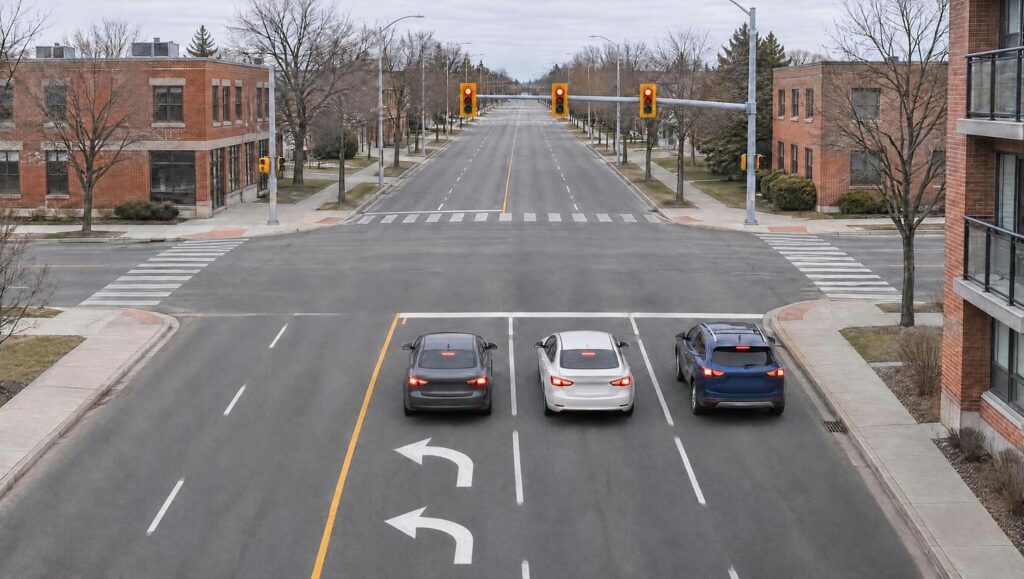
On the insurance side, fault is matched rather than argued. The adjuster works out which written scenario the shape of your collision fits, then reads off the share that scenario carries. So the facts worth contesting are the ones that select the scenario: lane position, direction of travel, who was moving and who was stopped, who entered the intersection first, whether a sign or a signal was involved, and whether anyone was turning or changing lanes.
It is also why the police report does not settle it, and why an uncharged driver can still carry the whole share. The officer’s conclusion about blame is not one of the facts the rule asks for. The factual content of the report is different: it can be the evidence that establishes which scenario applies, since several scenarios turn on who failed to obey a sign or a signal.
The grid of pre-written scenarios will not weigh driver behaviour in the round to decide who was more careless, but plenty of those scenarios are defined by driver conduct: changing lanes, failing to yield, running a stop sign, backing up, opening a door. Each impact in a multi-car crash is worked out on its own, so a driver can be treated differently in two collisions from the same pile-up. And a photograph, a dashcam clip or an independent witness moves a fault finding when a description of how unavoidable it felt does not.
What the Rules Are Told to Ignore
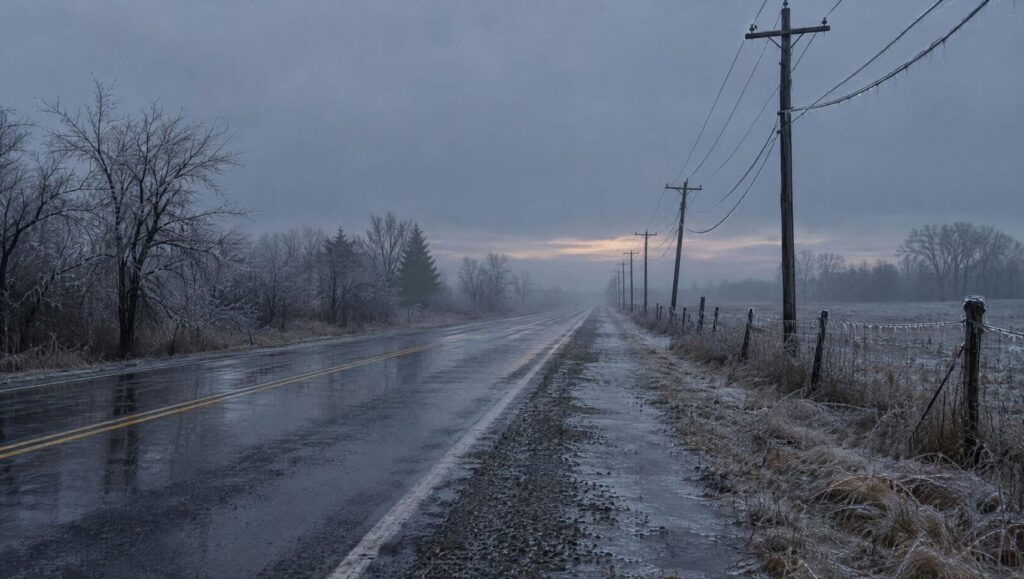
Here is the part that makes people angry, and it is worth stating plainly. Fault is worked out without reference to the circumstances in which the crash happened, including the weather, the road conditions, the visibility and what any pedestrian did. It is also worked out without reference to where on your car the other vehicle made contact. Black ice, an unlit rural road, a sun straight in your eyes: none of that is an input.
That is not an oversight. It is the design. A grid that weighed all of those things would need a hearing for every fender bender, and the system exists to produce a fast, predictable, repeatable number so that vehicles get paid out and files close. The trade is deliberate: you lose the chance to explain yourself, and in exchange you get an answer quickly rather than after a trial.
Because the rules leave what a pedestrian did out of the calculation entirely, a person on foot sits in a different position altogether, and who is at fault when a pedestrian is hit by a car runs on different law.
What the Rules Assign in Common Ontario Collisions
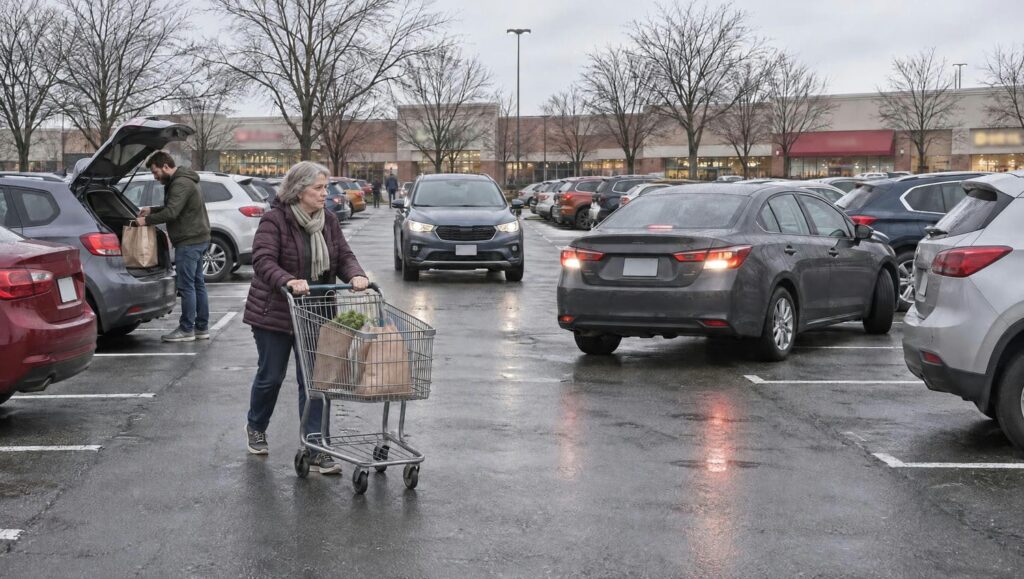
These are the collisions people ask about most, not the full set, because the rules reach more than 40 situations. What moves the number is almost never how careful anyone was being. It is the geometry: who was where, who was moving, and what was being passed or crossed.
| What happened | What the rules assign | The detail that decides it |
| You were rear-ended while stopped or moving forward | The driver who hit you carries all of it | Holds whether you were stopped in traffic or still rolling forward |
| You were rear-ended while turning into a side road or driveway | The driver who hit you carries all of it | The turn does not shift it |
| You were struck by a car changing lanes into you | The lane-changing driver carries all of it | The manoeuvre, not the point of impact |
| You were turning left at an intersection and a car overtook you | You carry a quarter, the passing driver three quarters | The only scenario in the regulation that produces these two shares |
| You were turning left into a private road or driveway and a car overtook you | Shared evenly | The same manoeuvre, a different place, a different answer |
| Two cars sideswipe and where each one was on the road cannot be established | Shared evenly | The split is the answer to an unprovable fact |
| Nobody can establish who entered the uncontrolled intersection first | Shared evenly | Same mechanism, intersection version |
| One driver ran a stop sign or a red light | That driver carries all of it | If both drivers ran the stop sign, it is shared evenly |
| You pulled out of a parking space in a lot and did not yield | You carry all of it | The lot’s main through road ranks above the aisle you were leaving |
| You were backing up, making a U-turn, or you opened your door | You carry all of it | Three situations that rarely feel like carelessness |
| Your legally parked car was struck | The driver who struck it carries all of it, unless the car was parked, stopped or standing illegally and the collision happened outside a city, town or village, in which case the parked driver carries all of it | The geography is part of the rule, and the GTA is inside it |
| Three cars in a chain reaction, all three moving, you are in the middle | You carry half of the collision with the car ahead of you, and the driver behind you carries all of the collision with you | Each impact in the chain is worked out on its own |
| Three cars in a chain reaction, you are in the middle and only the car behind you was moving | You carry none of the collision with the car ahead of you, and the driver behind you carries all of the collision with you | The same chain, a different starting position |
Rear-End Collisions, Including the Ones That Feel Unfair
Most drivers already expect that answer. The question they actually arrive with is different: does it change if the car in front should not have been stopped there? The plain answer is that the rules contain no rear-end exception for a car stopped where it should not have been. There is one place fault flips onto a stationary vehicle, and it is narrow: a car parked, stopped or standing illegally and struck outside a city, town or village, which does not describe a collision in Toronto, Vaughan, Markham, Mississauga, Brampton or Scarborough. Inside a municipality, the driver who hit you still carries it.
One Left Turn, Three Different Splits
Take one manoeuvre: a driver turning left who gets overtaken. At an intersection, the turning driver carries a quarter and the passing driver three quarters. At a private road or driveway, the same manoeuvre is shared evenly. And if the passing driver was going past cars that had stopped behind the turning driver, the passing driver carries all of it. Nothing about carelessness changed across those three. Only the place, and what was being passed. A quarter and three quarters appear in exactly one scenario in the whole regulation, and everywhere else the answer is no fault, an even split, or all of it.
Parking Lots, Signs and a Police Officer’s Direction
Lanes in a parking lot are ranked, and that ranking explains every parking lot answer. The main road running into, through and out of the lot is treated as a road, with the rules applying to it as though it were one, while the smaller aisles feed into it. That is why a driver leaving an aisle and a driver leaving a space both carry the whole share when they fail to yield. A separate rule covers signs and directions: ignoring a police officer’s direction, or a do-not-enter, no-passing or no-turn sign, puts the whole share on the driver who ignored it.
Where a 50/50 Split Comes From
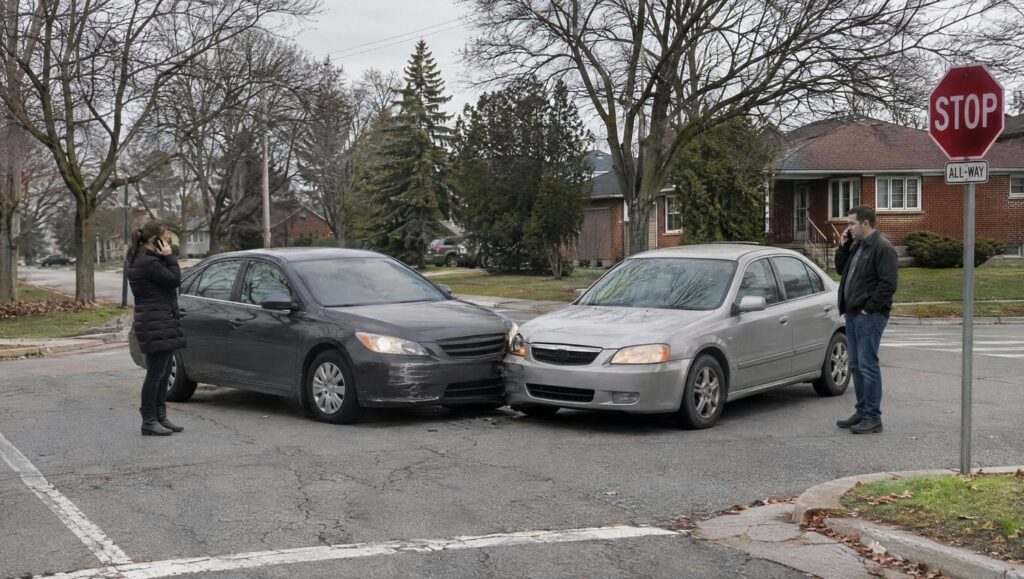
An even split is not the adjuster splitting the difference to avoid a fight. The rules themselves call for one in a number of situations, and knowing which situation applied tells you whether there is anything to work with.
When Two Rules Both Fit Your Accident
Not every rule cuts against you. If more than one rule applies to you, the one giving you the smaller share is treated as the only rule that applies. The exception is a head-on conflict: if two rules both fit a crash between two vehicles, and one puts you at all of it while the other puts you at none, you are treated as half at fault. So a 50 per cent finding can be the product of two rules both fitting, with nobody having formed a view about your driving.
When a Fact Cannot Be Established
The rules also call for an even split when a particular fact cannot be made out. Where each car was on the road when they sideswiped. Who entered the uncontrolled intersection first. Who failed to obey the stop sign. Who arrived first at the all-way stop. Whether either driver ran the signal. In every one of those, the even split is the answer to a blank, not a finding that both drivers erred.
Some even splits are substantive rather than a gap in the evidence, and they are worth telling apart from the rest: two cars that were both over the centre line when they sideswiped, and a pile-up of three or more cars travelling the same way in adjacent lanes, where each collision in it is split evenly. If your finding came from a blank rather than from one of those, the thing to go looking for is the evidence that fills it.
When No Rule Fits at All
The grid is not exhaustive. If your accident is not described in any of the rules, or there is not enough information to apply one, your insurer has to determine fault under ordinary law instead, unless one of the rules specifically requires a particular answer. That matters for a practical reason. This is the one route where the circumstances of the crash come back into the insurance decision, which is another argument for gathering evidence early.
When a Driving Charge Changes Which Rules Apply
One set of serious charges takes a collision out of the grid altogether. The charges that count are specific: driving while impaired by alcohol or a drug, driving over the legal blood alcohol limit, an indictable offence connected to the operation of the vehicle, failing or refusing to give a breath sample after being asked for one, and exceeding the speed limit by 16 or more kilometres an hour. That last one surprises people. Sixteen over is enough.
What the charge does is conditional on two things together: a driver charged with one of those offences as a result of the crash, and the other driver carrying some share of fault under the rules. When both are true, fault is determined under ordinary law rather than read off the grid. A charge on its own does not do it, and neither does the other driver’s share on its own.
The collision has not been decided in anyone’s favour. It has been moved out of a fast mechanical exercise and into one that looks at the whole of the driving. The benefits side of an impaired driving charge is a separate question, and how an impaired driving charge affects accident benefits turns on different rules entirely.
What the Percentage Actually Changes
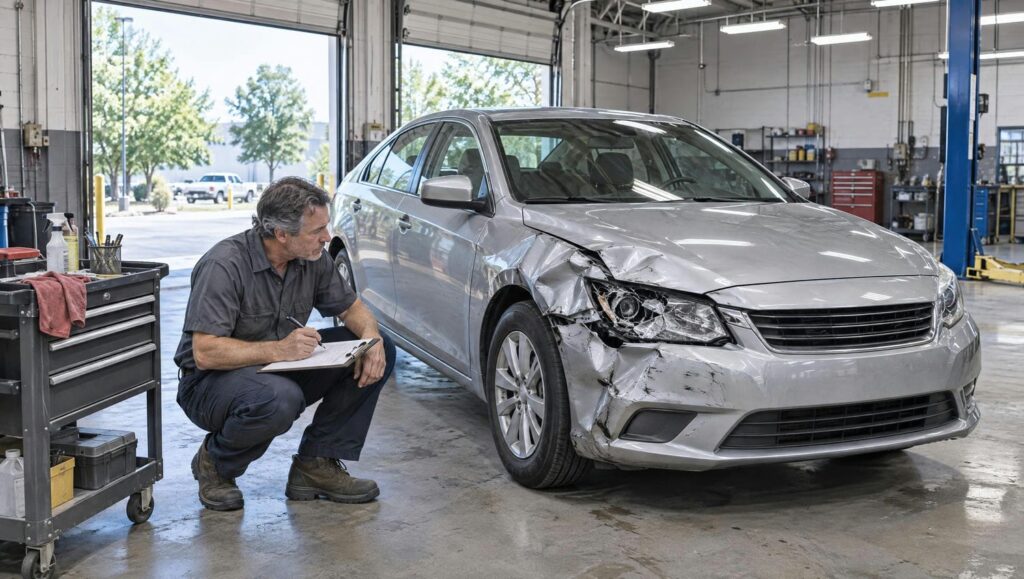
A finding of fault goes on your insurance record. At 50 per cent or more there is a good chance your premium goes up at renewal. So the gap between a quarter and a half is not cosmetic: an overtaken left turn at an intersection leaves the turning driver at a quarter, below that line, and the same turn into a driveway leaves them at a half, on it.
The percentage governs one payment in particular: what you are paid for your own vehicle. Ontario policies include direct compensation property damage coverage, which pays for damage to your car through your own insurer, and what you receive depends on how far your insurer found you at fault. Found 50 per cent or more at fault, and the company pays 50 per cent of the loss, less the deductible. That deductible is the property damage deductible on your own vehicle’s coverage. Since January 2024 a driver has been able to sign that coverage away in writing, and a driver who did is in a different position when a percentage lands, because that is the coverage the percentage governs.
Accident benefits come from your own insurer and are available regardless of who caused the accident, so a fault finding does not shut off medical and rehabilitation support. The benefits claim and the fault argument run on separate tracks. Waiting for the fault question to settle before claiming benefits costs the injured person treatment, and it is an expensive mistake.
Why That Percentage Does Not Decide Your Injury Claim
The regulation tells an insurer how to rate its own insured, and it does that while leaving the circumstances of the crash out. A calculation built on those two instructions was never going to be the one that decides who pays for an injury. A different body, applying different law, does that.
How a Court Divides Fault Instead
A court is doing a different job: not matching your collision to a pre-written scenario, but deciding, on the evidence in your case, how much of the damage each person’s conduct caused.
In a claim for damages founded on the other side’s fault or negligence, where the injured person’s own fault contributed to the damages, the court apportions the damages in proportion to the degree of fault it finds against each party.
Where damages have been caused or contributed to by the fault or neglect of two or more persons, the court, not an insurer, determines each person’s degree of fault. Parties whose shares cannot practicably be determined are treated as equally at fault, so that system has its own answer when the evidence runs out. What a court may look at is everything the grid was told to leave out.
What Your Share Does and Does Not Cost You
If you are holding a number right now, here is what it does and does not do. A share of fault reduces what an injured person recovers. It does not end the right to claim. And the insurer’s percentage is not the court’s percentage. It did not come from the same inputs, so a driver told they are 50 per cent at fault for insurance purposes has not been told what their injury claim is worth. Two decisions, made by a different body, on different material, at a different time. The number that decides an injury claim is produced somewhere else.
If You Think the Fault Finding Is Wrong

Whether a percentage can move depends on the facts that selected the rule. So the useful first step is not an argument about blame. It is finding out which rule was applied to your accident and what that rule turns on.
Ask Which Rule Was Applied
If you think your insurer got it wrong, ask your claims adjuster which fault determination rule was applied to your accident, and ask for the full details. Ask for it in writing. That question beats arguing about blame for a simple reason. The rule names the facts that are doing the work, so it tells you whether you are arguing about lane position, about who entered the intersection first, or about something the rule does not care about at all.
The Complaint Officer and the Regulator
If the company will not revise its decision, the next step is the insurer’s own complaint officer, and after that a complaint can go to Ontario’s insurance regulator, the final step in the complaint route it publishes for policyholders.
The regulator takes complaints about how an insurer handled a claim and can look at whether the company followed the rules it has to follow. Changing the percentage itself is a different job, done with your insurer, through its complaint officer, or in court. Keep one eye on the calendar. A fault dispute can run for months, and the deadlines that apply to a car accident claim are separate and strict.
Where a Lawyer Fits Once a Percentage Has Been Assigned
Once a percentage has been assigned, the work is specific: identify which rule your insurer applied, test the facts that selected it, and run the injury claim on its own footing rather than on the insurer’s number. Our team has more than 30 years of collective personal injury experience, you deal directly with the lawyer handling your file, and HSK Law works on a no win no fee basis. If you have been handed a number you do not understand, a conversation with a car accident lawyer will tell you what it governs and what it does not. We will arrange a free consultation and look at the whole file with you.
Frequently Asked Questions
These are the questions drivers ask most after a percentage lands, with the insurer’s letter still in hand and the number already sitting on the file.
No. Your insurer’s percentage was produced under a regulation that tells insurance companies how to assess their own insureds, and it is not the decision a court makes about an injury claim. A share of fault reduces what an injured person recovers rather than ending the right to claim, and the two exercises run on different material.
No. The diagrams in the regulation illustrate the situations the written rules describe, so the words of the rule govern and the picture is a drawing of those words. The useful question is which rule the diagram is illustrating, so ask your adjuster to name it and to give you the full details.
Neither. Each insurer determines the degree of fault of its own insured, so two determinations can disagree and neither one binds the other. Neither is a ruling on an injury claim either. The practical move is to ask each insurer which rule it applied, because that tells you where the two accounts of the collision diverge.
No. As of July 2026, medical, rehabilitation and attendant care benefits stayed mandatory while most other accident benefits became optional. That was a change to accident benefits, the support your own insurer pays after an injury. How your insurer decides who was at fault is a separate exercise and the July changes did not touch it.
Yes, if the driver was found 50 per cent or more at fault. An accident in your vehicle goes on your insurance record as well as theirs, which catches out people who hand over the keys to a family member or a friend. It is worth knowing before you lend the car, not after.
It depends on the facts that selected the rule. Start by finding out which rule was applied and what it turns on, then look at whether the evidence settles a fact the rule needs. Where a rule applied because something could not be established, evidence that establishes it is the thing that matters.
Book a FREE consultation
Submit the form below or call (416) 238-7105 to find out if you have a claim!
"*" indicates required fields